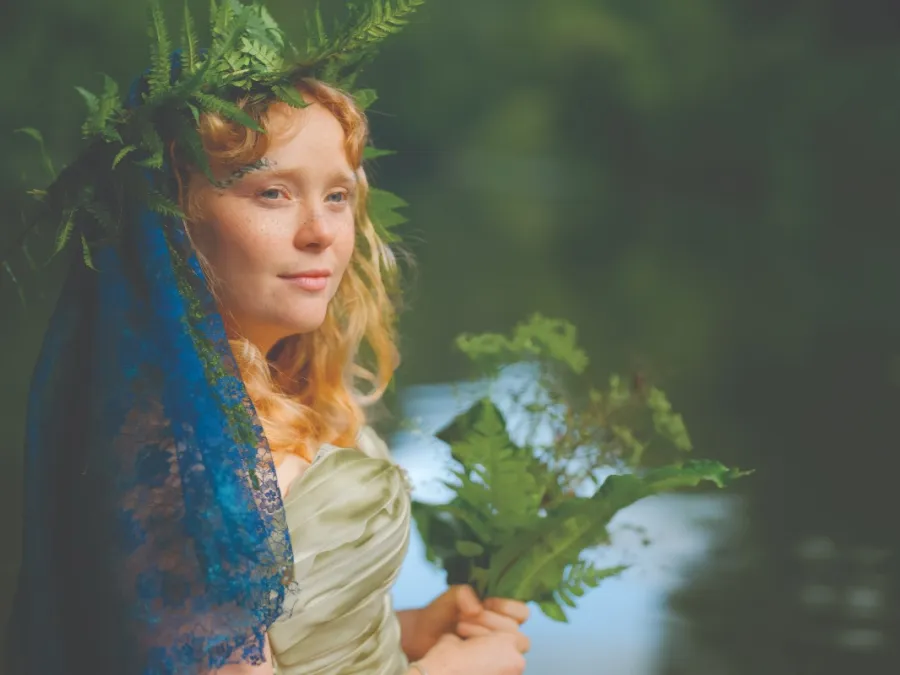
Meg Avon is a Bristol-based performance poet, river rights researcher and campaigner with We Are Avon, and, since summer 2023, the UK’s first River Bride.
The Avon wasn’t a river I knew I could swim in until lockdown, when I was taken to a magical part of the river to the east of the city – Conham River Park. It’s still my favourite place to swim. It’s easy to access, with steps down to the water, opposite the pub Beeses. There’s always someone having a drink or listening to music at the pub. Then there’s the big meadow, where I got married to the river, which is on the edge of a nature reserve. So you see all these incredible herons and cormorants. I never was into birds before I started swimming as regularly as I do now, but you slip into the unseen and feel part of the natural world, being a less dangerous part of it, naked or with your skin bared, swimming along with everything else.
It’s hard to describe the life of a River Bride. That idea of ceremony, which brought me into a career of river rights campaigning and research, came into being because I took those vows quite seriously. Not to say we didn’t organise the wedding lightheartedly, but I didn’t think it would have as much resonance as it has. We tried to make the vows shared, about care and commitment till death do us part, and the community that had come together wanted to witness that union and be part of it. Everywhere I go now, there’s this sense of people realising things aren’t right with the water and that is emblematic of things not being right in society. It’s a good place to start to make change because we know how quickly we won’t survive without clean water, and we know how easily water connects us from the sink in our kitchen to the Pacific Ocean, and all the way back through the weather cycle, through our cell makeup.
I see my work as three-pronged. There is the legal, political, policy-making aspect, which is what I’m researching with UWE, travelling around the UK, helping create a local charter with a list of river rights linked to existing environmental laws. The law is an influential part of our existence; whether we abide by it or not, and who does or doesn’t, is very interesting. It can’t be powerful on its own, which is why the grassroots movement – river guardians, guardianship groups and bioregional action – is important for implementing those policies locally to have an effect nationally. And the third prong is culture shift, story-making; seeing where you fit into the story of your locality and how that fits into the wider picture. We need to be wary of how we treat the natural world because there are strong forces that can squash us flat. But also, that element of loving nature and being in kinship with our landscape and how that will help keep our brains sane, our bodies healthy and our communities strong.
Pilgrimage has always been a big part of this campaign for me. It’s such a wonderful way to unwind what’s been tied into a tight knot in your mind but you’ve never had the space to loosen it and take a different perspective. Being able to dedicate days focusing on what we need – shelter, clean water, food, some form of entertainment, light and love – reduces everything down to just that. It feels empowering to be able to move through the landscape and connect the trees and the rivers and the birds and arrive at your destination, which is the source or mouth of the river, and realise it’s not the end, water carries on. It’s pretty magic, especially in a landscape that has been so taken away from us, with so much of our land and waterways in England being privatised.
I feel nourished by and secure within the creative environment we’ve got in the southwest. Things like making the Avona river spirit puppet last year at the Puppet Place – that was a lovely this-could-only-happen-in-Bristol sort of feeling. This river campaign needs it all: we need the scientist, the lawyer, the politician, the biologist, the ecologist, the mathematician… But art is how we communicate the story to those who are next; that’s the stuff that lasts for generations to come. That’s how I partake. And my poetry is a similar thing: a community I felt almost too nervous to join and didn’t feel was a part of my identity I wanted to name, until I realised I had a story to tell, and the river was giving me the support and platform to do that.
The 'Bride' pic is photographer Charlotte Sawyer, taken from Rave on For the Avon Film Still
The other three water pics are Sasha Pollington
