Dance Out is a forthcoming exhibition at the Royal West of England Academy (RWA), opening in early May. Bringing together paintings, drawings and films from a range of artists, it explores the many meanings and forms of dance across different cultural and historical contexts. Rather than focusing on dance as performance or spectacle, the show presents it as an everyday human activity, something embedded in social life, memory and collective experience. Dance appears not only as movement, but as a language through which communities express identity, intimacy and resistance.
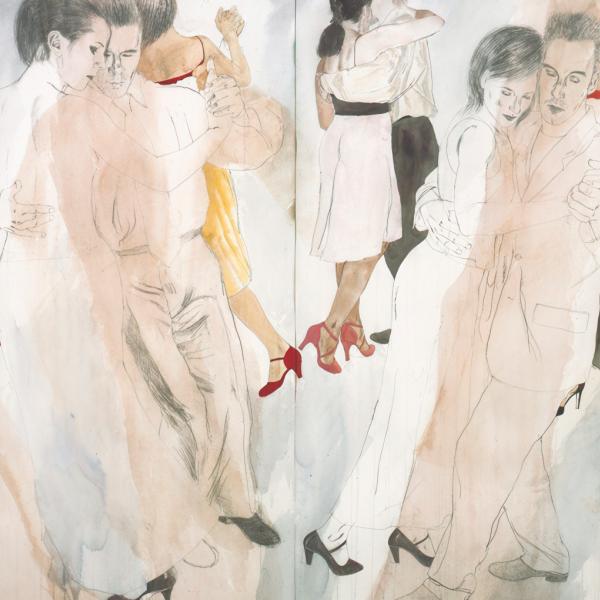
The exhibition was co-curated by David Remfry RA and features some of the large-scale watercolours he produced during his two decades living and working in New York’s legendary Chelsea Hotel. Remfry’s paintings capture the social worlds that unfolded around him, depicting the bodies of artists, performers and writers caught mid-movement in luminous washes of colour that evoke the energy and intimacy of New York dancefloors. He was compelled to investigate how movement can be an intimate lens through which to explore human relationships. The paintings of Grenada-born Denzil Forrester, on the other hand, rattle with the impact of 1980s reggae and dub sound systems in London, celebrating these gatherings as crucial expressions of Black British cultural identity. In a similar vein, Paul Dash explores how Afro-Caribbean culture, memory and tradition are preserved through diasporic practices such as street festivals and carnivals, where music and dance transform public spaces into sites of celebration and cultural continuity.
Other works turn towards the solitary dancer. Tracey Emin’s Why I Never Became a Dancer is autobiographical, recalling a time she was slut-shamed as a teenager and positioning dance as a form of feminist resistance. Gillian Wearing’s 1994 film Dancing in Peckham, meanwhile, shows the conceptual artist arriving at the Aylesham Centre and dancing ecstatically for 25 minutes to only the ambience echoing beneath the shopping centre’s vaulted glass roof.
Wearing was recreating a scene she had previously encountered at the Royal Festival Hall: another woman dancing wildly by herself, as if either totally oblivious to – or consciously infringing upon – the expectations of how one should occupy a public place. One of the top comments on a YouTube snippet of the film, left in 2021, reads: “So she invented TikToks?” Facetiousness aside, Wearing’s Dancing in Peckham raises a question that feels even more relevant now: how can an individual’s behaviour blur the line between public and private space?
If we were to encounter Wearing dancing in a shopping centre today, we might instinctively look around us for the device capturing the moment – and the proliferation of self-shot dancing videos has not gone unnoticed by digital media artist Melanie Manchot. In fact, this is how she sourced the participants for Dance the Night Away, an immersive installation made in Bristol with local dancers and commissioned by the RWA for Dance Out.
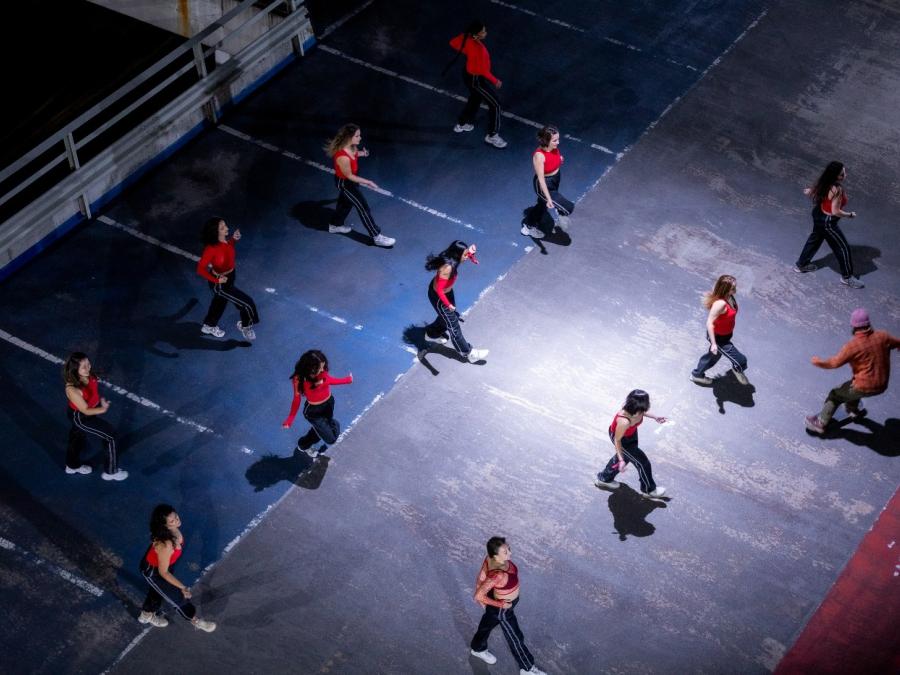
In the 18-minute film, made for five screens, the dancers Manchot found on TikTok and Instagram – including junglist and former Lord Mayor of Bristol Cleo Lake, and, apart from LGBTQ+ morris dance group Molly Nomates, all dancing alone – perform styles of dance rooted in various diasporic and folk cultures. Each sequence unfolds at night in a different urban setting: under a bridge, in an industrial park, on an empty street. The choice of locations is deliberate. The film asks a simple but unsettling question: how public are these places, really? “We think of parks, sidewalks, squares as public space,” Manchot explains, “but our cities are increasingly privatised.”
The reclamation of ownership and agency is central to the work. “It’s not just reclaiming space, it’s also reclaiming the night,” Manchot asserts. With each dancer being a woman, gender non-conforming person or from a global majority community, their nighttime dancing becomes an act of visibility and empowerment within environments that might otherwise feel unsafe or unwelcoming.
Manchot left the choreography entirely to the dancers. Each sequence unfolds in a single, uncut shot, with the performance taking precedence. Shot from a CCTV-like overhead position and displayed to resemble a video control room, the installation reminds us that in contemporary cities, we are almost always performing to some form of remote observer. By allowing the dancers to lead the production, Manchot reframes the gaze so it becomes an act of acknowledgement rather than surveillance. “They already hold the space where we find them,” she explains. “It’s their space, and they have agency within it.”
The film gestures toward the coexistence of differences within shared urban environments, rather than assimilation, acknowledging diversity as something that should remain visible and valued. In the final sequence, the dancers gather on the roof of a multi-storey car park, this time accompanied by troupes from their respective communities, all dancing together. As Manchot explains, they are not “becoming one set of people”, but instead “retain [their] individual histories and cultures alongside each other”.
Dance Out’s celebration of collective joy carries a note of urgency, given the pressures facing nightlife culture, exacerbated by the opportunities the COVID pandemic gave developers to further undermine its value. For Manchot, dancing creates a unique form of connection – both with others and with ourselves. Dancing with strangers, “absorbing their energy”, transcends personal relationships and allows for a connection with a “wider sense of humanity”. Clubs and festivals facilitate these opportunities in a way that is almost impossible to imagine elsewhere.
What Manchot’s film, along with the other works in Dance Out, demonstrates is that space is never neutral but is continually shaped through the movements of those who inhabit it. The political force of public dancing lies precisely in its nature as an entirely peaceful and legal act, allowing individuals and communities to occupy spaces in ways that are difficult to regulate, suppress or control. In more intimate or private contexts, dance can be a means of asserting presence, memory and agency against forces that seek to constrain them. In this sense, whether unfolding on a Bristol rooftop, a Wiltshire field or in the quiet defiance of a solitary dancer wigging out in a supermarket, movement becomes a way of reshaping space itself.
Dance Out runs at RWA, Bristol, from 9 May to 9 August.